Adventurine/Green Quartz
Aventurine is a form of quartz, characterised by its translucency and the presence of platy mineral inclusions that give a shimmering or glistening effect . The most common colour of aventurine is green, but it may also be orange, brown, yellow, blue, or gray. Chrome-bearing fuchsite (a variety of muscovite mica) is the classic inclusion, and gives a silvery green or blue sheen. Oranges and browns are attributed to hematite or goethite. Because aventurine is a rock, its physical properties vary: its specific gravity may lie between 2.64-2.69 and its hardness is somewhat lower than single-crystal quartz at around 6.5.

Granite
Granite is a common and widely occurring type of intrusive, felsic, igneous rock. Granites usually have a medium- to coarse-grained texture. Occasionally some individual crystals (phenocrysts) are larger than the groundmass, in which case the texture is known as porphyritic. A granitic rock with a porphyritic texture is sometimes known as a porphyry. Granites can be pink to gray in color, depending on their chemistry and mineralogy. By definition, granite has a color index (the percentage of the rock made up of dark minerals) of less than 25%. Outcrops of granite tend to form tors and rounded massifs. Granites sometimes occur in circular depressions surrounded by a range of hills, formed by the metamorphic aureole or hornfels. Granite is usually found in the continental plates of the Earth's crust.
Moon Stone
Its name is derived from a visual effect, or sheen, caused by light reflecting internally in the moonstone from layer inclusion of different feldspars.Moonstone has been used as jewelry for centuries, including ancient civilizations. The Romans admired moonstone, as they believed it was born from solidified rays of the moon. Both the Romans and Greeks associated Moonstone with their lunar gods and goddesses. In more modern times, moonstone jewelry was also common in the United States as a part of the Art Nouveau movement, but their usage waned by the mid 1920s. The most common moonstone is of the mineral adularia. The plagioclase feldspar oligoclase also produces moonstone specimens. Moonstone is feldspar with a pearly and opalescent luster. An alternate name is hecatolite. Moonstone is composed of two feldspar species, orthoclase and albite. The two species are intermingled. Then, as the newly formed mineral cools, the intergrowth of orthoclase and albite separates into stacked, alternating layers. When light falls between these thin, flat layers, it scatters in manydirections producing the phenomenon called adularescence.

Copper
Copper is a chemical element with the symbol Cu (Latin: cuprum) and atomic number 29. It is a ductile metal,with very high thermal and electrical conductivity. Pure copper is rather soft and malleable, and a freshly exposed surface has a reddish-orange color. It is used as a thermal conductor, an electrical conductor, a building material, and a constituent of various metal alloys.

Hematite
Hematite, also spelled as haematite, is the mineral form of iron oxide, one of several iron oxides. Hematite crystallizes in the rhombohedral system, andit it has the same crystal structure as ilmenite and corundum. Hematite and ilmenite form a complete solid solution at temperatures above 950°C.
Hematite is a mineral, colored black to steel or silver-gray, brown to reddish brown, or red. It is mined as the main ore of iron. Varieties include kidney ore, martite (pseudomorphs after magnetite), iron rose and specularite (specular hematite). While the forms of hematite vary, they all have a rust-red streak. Hematite is harder than pure iron, but much more brittle. Maghemite is a hematite- and magnetite-related oxide mineral.
Huge deposits of hematite are found in banded iron formations. Grey hematite is typically found in places where there has been standing water or mineral hot springs, such as those in Yellowstone National Park in the United States. The mineral can precipitate out of water and collect in layers at the bottom of a lake, spring, or other standing water. Hematite can also occur without water, however, usually as the result of volcanic activity.
Clay-sized hematite crystals can also occur as a secondary mineral formed by weathering processes in soil, and along with other iron oxides or oxyhydroxides such as goethite, is responsible for the red color of many tropical, ancient, or otherwise highly weathered soils.

Amethyst Stones
Amethyst is a violet variety of quartz often used in jewelry. The name comes from the Ancient Greek ἀ a- ("not") and μέθυστος methustos ("intoxicated"), a reference to the belief that the stone protected its owner from drunkenness; the ancient Greeks and Romans wore amethyst and made drinking vessels of it in the belief that it would prevent intoxication.
Jasper
Jasper, a form of chalcedony,is an opaque,impure variety of silica, usually red, yellow, brown or green in color; and rarely blue. This mineral breaks with a smooth surface, and is used for ornamentation or as a gemstone. It can be highly polished and is used for vases, seals, and at one time for snuff boxes. When the colors are in stripes or bands, it is called striped or banded jasper. Jaspilite is a banded iron formation rock that often has distinctive bands of jasper. Jasper is basically chert which owes its red color to iron inclusions

Sandstone
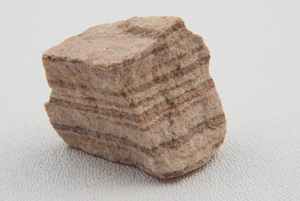
Sandstone (sometimes known as arenite) is a sedimentary rock composed mainly of sand-sized minerals or rock grains. Most sandstone is composed of quartz and/or feldspar because these are the most common minerals in the Earth's crust. Like sand, sandstone may be any color, but the most common colors are tan, brown, yellow, red, gray and pink, white. Since sandstone beds often form highly visible cliffs and other topographic features, certain colors of sandstone have been strongly identified with certain regions.
Some sandstones are resistant to weathering, yet are easy to work. This makes sandstone a common building and paving material. However, some that have been used in the past, such as the Collyhurst sandstone used in North West England, have been found less resistant, necessitating repair and replacement in older buildings.[1] Because of the hardness of the individual grains, uniformity of grain size and friability of their structure, some types of sandstone are excellent materials from which to make grindstones, for sharpening blades and other implements. Non-friable sandstone can be used to make grindstones for grinding grain, e.g., gritstone.
Rock formations that are primarily composed of sandstone usually allow percolation of water and other fluids and are porous enough to store large quantities, making them valuable aquifers and petroleum reservoirs. Fine-grained aquifers, such as sandstones, are more apt to filter out pollutants from the surface than are rocks with cracks and crevices, such as limestone or other rocks fractured by seismic activity.
Colored Agate Stones/Slabs
Agate is a microcrystalline variety of quartz (silica), chiefly chalcedony, characterised by its fineness of grain and brightness of color. Although agates may be found in various kinds of rock, they are classically associated with volcanic rocks but can be common in certain metamorphic rocks.
Pyrite
The mineral pyrite, or iron pyrite, is an iron sulfide with the formula FeS2. This mineral's metallic luster and pale-to-normal, brass-yellow hue have earned it the nickname fool's gold because of its resemblance to gold. The color has also led to the nicknames brass, brazzle and Brazil, primarily used to refer to pyrite found in coal.
Pyrite is usually found associated with other sulfides or oxides in quartz veins, sedimentary rock, and metamorphic rock, as well as in coal beds, and as a replacement mineral in fossils.


Rose Quartz
Rose quartz is a type of quartz which exhibits a pale pink to rose red hue. The color is usually considered as due to trace amounts of titanium, iron, or manganese, in the massive material. Some rose quartz contains microscopic rutile needles which produces an asterism in transmitted light. Recent X-ray diffraction studies suggest that the color is due to thin microscopic fibers of possibly dumortierite within the massive quartz.


Calcite
Calcite is a carbonate mineral and the most stable polymorph of calcium carbonate (CaCO3). The other polymorphs are the minerals aragonite and vaterite. Aragonite will change to calcite at 470 °C, and vaterite is even less stable.
Calcite is a common constituent of sedimentary rocks, limestone in particular, much of which is formed from the shells of dead marine organisms. Calcite is the primary mineral in metamorphic marble. It also occurs as a vein mineral in deposits from hot springs, and it occurs in caverns as stalactites and stalagmites.
Calcite may also be found in volcanic or mantle-derived rocks such as carbonatites, kimberlites, or rarely in peridotites. Lublinite is a fibrous, efflorescent form of calcite.
Calcite is often the primary constituent of the shells of marine organisms, e.g., plankton (such as coccoliths and planktic foraminifera), the hard parts of red algae, some sponges, brachiopods, echinoderms, most bryozoa, and parts of the shells of some bivalves (such as oysters and rudists). Calcite is found in spectacular form in the Snowy River Cave of New Mexico as mentioned above, where microorganisms are credited with natural formations. Trilobites, which are now extinct, had unique compound eyes. They used clear calcite crystals to form the lenses of their eyes.

Peridot
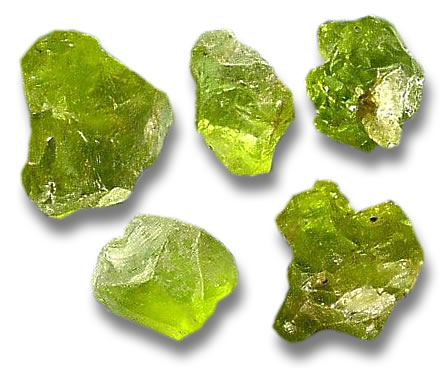
Peridot is one of the few gemstones that occur in only one color, an olive green. The intensity and tint of the green, however, depends on how much iron is contained in the crystal structure, so the color of individual peridot gems can vary from yellow- to olive- to brownish-green. The most valued color is a dark olive-green. Peridot is a common mineral in mafic and ultramafic rocks, and it is often found in lavas and in peridotite xenoliths of the mantle, which lavas carry to the surface; but gem quality peridot only occurs in a fraction of these settings.

Tiger Eye
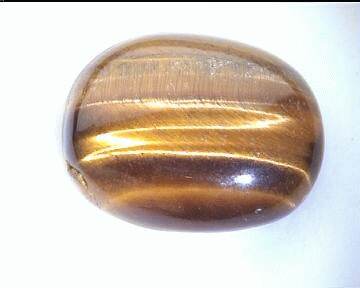
Tiger's eye (also called Tigers eye or Tiger eye) is a chatoyant gemstone that is usually a metamorphic rock that is a golden to red-brown color, with a silky luster. A member of the quartz group, it is a classic example of pseudomorphous replacement by silica of fibrous crocidolite (blue asbestos).


The Hydration of the tiger's eye will determine how Golden brown, red, green or blue, the Tiger's Eye will be:
Golden Tiger Eye
Red Tiger Eye
![[tiger-eye-red.jpg]](http://1.bp.blogspot.com/_j5qrAQ3MidU/SdKdXpM6tQI/AAAAAAAAAPQ/Xvfxo88Feek/s1600/tiger-eye-red.jpg)
Brown Tiger Eye

Green Tiger Eye

Blue Tiger Eye/ Eagle Eye

Malachite
Malachite is a copper carbonate mineral. This green-colored mineral crystallizes in the monoclinic crystal system, and most often forms botryoidal, fibrous, or stalagmitic masses. Individual crystals are rare but do occur as slender to acicular prisms. Pseudomorphs after more tabular or blocky azurite crystals also occur.
Malachite often results from weathering of copper ores and is often found together with azurite, goethite, and calcite. Except for its vibrant green color, the properties of malachite are similar to those of azurite and aggregates of the two minerals occur frequently. Malachite is more common than azurite and is typically associated with copper deposits around limestones, the source of the carbonate.

Dalmation Jasper
Dalmation Jasper is a cryptocrystalline (microcrystalline) variety of quartz, meaning the crystals are too small to even be seen by a microscope. In Dalmation Jasper, the quartz microcrystals are laid out in sugar-like grains, rather than the fibrous layers found in chalcedony.

Obsidian
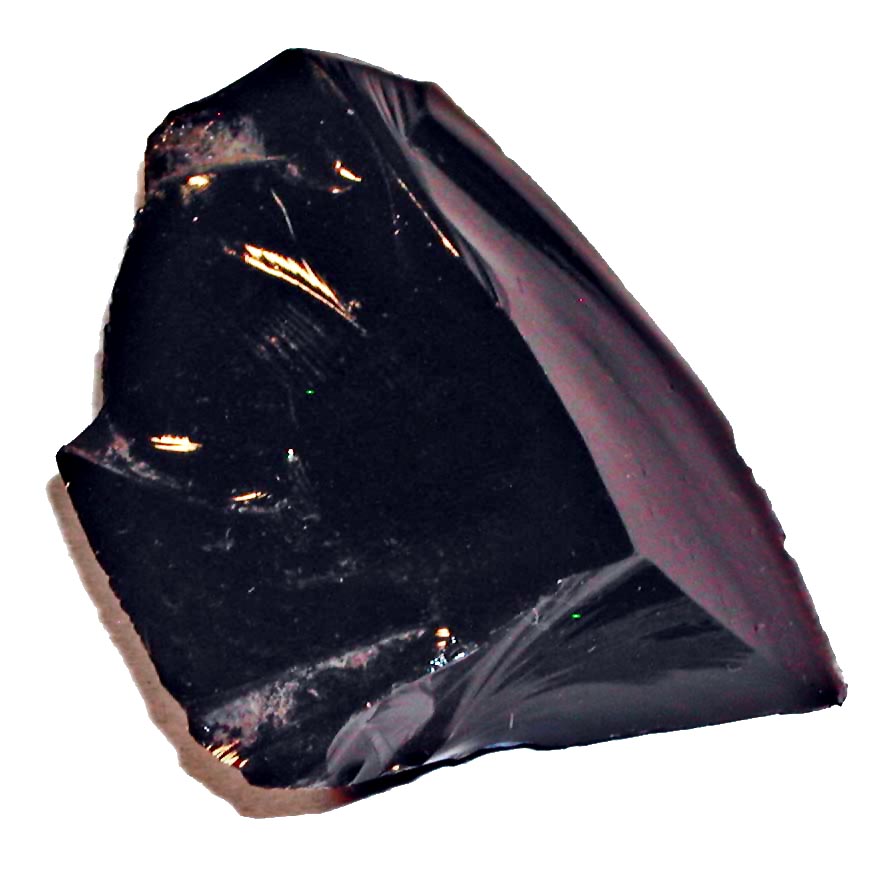
Obsidian is a naturally occurring volcanic glass formed as an extrusive igneous rock.
It is produced when felsic lava extruded from a volcano cools rapidly with minimum crystal growth. Obsidian is commonly found within the margins of rhyolitic lava flows known as obsidian flows, where the chemical composition (high silica content) induces a high viscosity and polymerization degree of the lava. The inhibition of atomic diffusion through this highly viscous and polymerized lava explains the lack of crystal growth.
Breccia
Breccia is a rock composed of broken fragments of minerals or rock cemented together by a fine-grained matrix, that can be either similar to or different from the composition of the fragments.
A breccia may have a variety of different origins, as indicated by the named types including sedimentary breccia, tectonic breccia, igneous breccia, impact breccia and hydrothermal breccia.

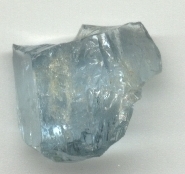
Aquamarine
Aquamarine is a blue or turquoise variety of beryl. The gem-gravel placer deposits of Sri Lanka contain aquamarine. Clear yellow beryl, such as occurs in Brazil, is sometimes called aquamarine chrysolite. When corundum presents the bluish tint of typical aquamarine, it is often termed Oriental aquamarine. The deep blue version of aquamarine is called maxixe. Its color fades to white when exposed to sunlight or is subjected to heat treatment, though the color returns with irradiation.

Rock Crystal
Rock Crystal is the name given to all clear colorless quartz. It is widely used as a popular ornamental stone and is also used as a gemstone. Although it is one of the least expensive gemstones, cut rock crystal has been used as imitation diamonds. Rock crystal lacks the fire, color (of course) and the rarity to be ranked as a fine precious gemstone.

Marble
Marble is a metamorphic rock composed of recrystallized carbonate minerals, most commonly calcite or dolomite.
Geologists use the term "marble" to refer to metamorphosed limestone; however stonemasons use the term more broadly to encompass unmetamorphosed limestone.
Marble is commonly used for sculpture and as a building material.

Unakite

White Magnetite
Magnetite is the most magnetic of all the naturally occurring minerals on Earth. Naturally magnetized pieces of magnetite, called lodestone, will attract small pieces of iron, and this was how ancient people first noticed the property of magnetism. Lodestones were used as an early form of magnetic compass. Magnetite typically carries the dominant magnetic signature in rocks, and so it has been a critical tool in paleomagnetism, a science important in discovering and understanding plate tectonics and as historic data for magnetohydrodynamics and other scientific fields. The relationships between magnetite and other iron-rich oxide minerals such as ilmenite, hematite, and ulvospinel have been much studied, as the complicated reactions between these minerals and oxygen influence how and when magnetite preserves records of the Earth's magnetic field.

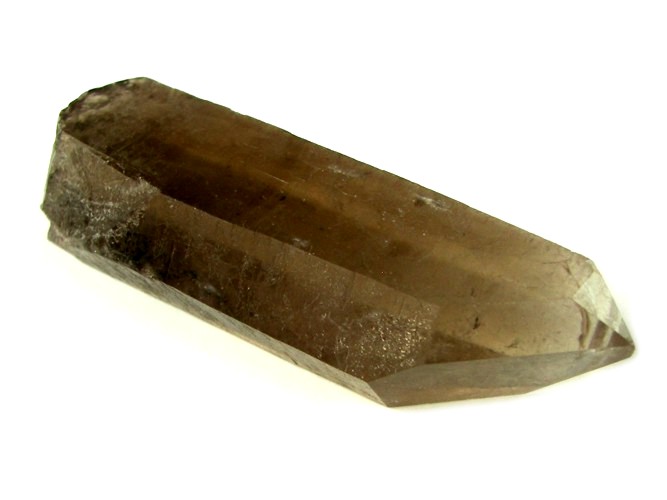
Smoky Quartz
Smoky quartz is a gray, translucent version of quartz. It ranges in clarity from almost complete transparency to a brownish-gray crystal that is almost opaque. Some can also be black.Like other quartz gems, it is a silicon dioxide crystal. The smoky colour results from free silicon, formed from the silicon dioxide by natural irradiation.
Fluorite
Fluorite is a halide mineral composed of calcium fluoride. It is an isometric mineral with a cubic habit, though octahedral and more complex isometric forms are not uncommon. Crystal twinning is common and adds complexity to the observed crystal habits.
Flourite is a colorful mineral, both in visible light and often under ultraviolet, and the stone has ornimental and lapidary uses. The purest grades of fluorite are a source of fluoride for hydrofluoric acid manufacture, which is the intermediate source of most fluorine-containing fine chemicals. Optically-clear transparent flourite lenses have low dispersion, so lenses made from it exhibit less chromatic aberration, making them valuable in microscopes and telescopes. Fluorite optics are also useable in the far-ultraviolet range where conventional glasses are too absorbent for use.

Tortilla Agate
Turritella agate is formed from silicified fossils. Similarly, coral, petrified wood and other organic remains or porous rocks can also become agatized. Agatized coral is often referred to as Petoskey stone or agate.


Desert Rose/Selenite
Desert rose is the colloquial name given to rosette formations of the minerals gypsum and barite with poikilotopic sand inclusions. The 'petals' are crystals flattened on the c crystallographic axis, fanning open along characteristic gypsum cleavage planes.
The rosette crystal habit tends to occur when the crystals form in arid sandy conditions, such as the evaporation of a shallow salt basin. Gypsum roses usually have better defined, sharper edges than barite roses.


Picture Jasper
Picture jasper is a petrified or silicated mud that dripped into gas pockets in molten lava. It became superheated and then solidified forming the unusual banded patterns which are typical of this stone.

Blue Lace
Agate describes a variety of cryptocrystalline quartz whose forms may include layers of different materials. Blue Lace agate is banded with pale blue and white layers.


Kyanite
Kyanite, whose name derives from the Greek word kuanos sometimes referred to as "kyanos", meaning deep blue, is a typically blue silicate mineral, commonly found in aluminium-rich metamorphic pegmatites and/or sedimentary rock. Kyanite in metamorphic rocks generally indicates pressures higher than 4 kilobars. Although potentially stable at lower pressure and low temperature, the activity of water is usually high enough under such conditions that it is replaced by hydrous aluminosilicates such as muscovite, pyrophyllite, or kaolinite.
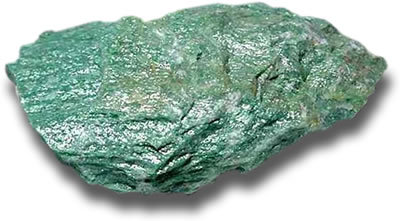
Fuchsite
Fuchsite is a green type of muscovite, high in chromium. The chromium makes the Fuchsite sparkle.
Iceland Spar
Iceland spar, formerly known as Iceland crystal, is a transparent variety of calcite, or crystallized calcium carbonate, originally brought from Iceland, and used in demonstrating the polarization of light (see polarimetry). It occurs in large readily cleavable crystals, easily divisible into rhombs, and is remarkable for its double refraction.

Labradorite
Labradorite, a feldspar mineral, is an intermediate to calcic member of the plagioclase series. The streak is white, like most silicates. As with all plagioclase members the crystal system is triclinic and three directions of cleavage are present two of which form nearly right angle prisms. It occurs as clear, white to gray, blocky to lath shaped grains in common mafic igneous rocks such as basalt and gabbro, as well as in anorthosites.

Opal
Opal is an amorphous form of silica related to quartz, a mineraloid form, not a mineral. It is deposited at a relatively low temperature and may occur in the fissures of almost any kind of rock, being most commonly found with limonite, sandstone, rhyolite, marl and basalt. Opal's internal structure makes it diffract light; depending on the conditions in which it formed it can take on many colors. Opal ranges from clear through white, gray, red, orange, yellow, green, blue, magenta, rose, pink, slate, olive, brown, and black. Of these hues, the reds against black are the most rare, whereas white and greens are the most common. It varies in optical density from opaque to semi-transparent. For gemstone use, its natural color is often enhanced by placing thin layers of opal on a darker underlying stone, like basalt.
Boulder Opal White Opal


Thunder Egg
A thunderegg is a nodule-like geological structure, similar to a geode, that is formed within a rhyolitic lava flow. Thundereggs are rough spheres, most about the size of a baseball - though they can range from less than an inch to over a meter across. They usually contain centres of chalcedony in the form of agate, jasper or opal, either uniquely or in combination. Also frequently encountered are quartz and selenite crystals, as well as various other mineral growths and inclusions. Thundereggs usually look like ordinary rocks on the outside, but slicing them in half and polishing them may reveal intricate patterns and colors. A characteristic feature of thundereggs is that (like other agates) the individual beds they come from can vary in appearance, though they can maintain a certain specific identity within them.

Snow Flake Obsidian
Snow Flake Obsidian is a type of obsidian where it has random botches of white in a snow flake patern in its jet black backround.

Banded agate
Some types of agate have layers of quartz in them, which forms Banded agate.

Carnelian
Carnelian is a brownish-red mineral which is commonly used as a semi-precious gemstone. Carnelian and sard is a variety of the silica mineral chalcedony colored by impurities of iron oxide. The color can vary greatly, ranging from pale orange to an intense almost-black coloration.

Turquoise
Turquoise is an opaque, blue-to-green mineral that is a hydrous phosphate of copper and aluminium. Even the finest of turquoise is fracturable, reaching a maximum hardness of just under 6, or slightly more than window glass. Turquoise almost never forms single crystals and all of its properties are highly variable. The lustrer of turquoise is typically waxy to subvitreous. Colour is as variable as the mineral's other properties, ranging from white to a powder blue to a sky blue, and from a blue-green to a yellowish green. The blue is attributed to copper while the green may be the result of either iron impurities (replacing aluminium) or dehydration.

Sodalite
Sodalite is a rich royal blue mineral widely enjoyed as an ornamental gemstone. Although massive sodalite samples are opaque, crystals are usually transparent to translucent. Sodalite is a member of the sodalite group and—together with hauyne, nosean, and lazurite—is a common constituent of lapis lazuli.

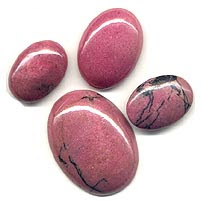
Rhodonite
Rhodonite is a manganese inosilicate and member of the pyroxenoid group of minerals, crystallizing in the triclinic system. It commonly occurs as cleavable to compact masses with a rose-red color, often tending to brown because of surface oxidation.

Chrysocolla
Chrysocolla is a mineral with an attractive blue-green colour and is a minor ore of copper.
It is of secondary origin and forms in the oxidation zones of copper ore bodies. Associated minerals are quartz, limonite, azurite, malachite, cuprite, and other secondary copper minerals.
It is typically found as glassy botryoidal or rounded masses and crusts, or vein fillings. Because of its light color, it is sometimes confused with turquoise. Commonly it occurs only as pourous crusts unsuitable for gem use, but high quality, gem grade chrysocolla can be translucent and is highly prized.

Alabaster
Alabaster is a name applied to varieties of two distinct minerals, when used as a material: gypsum and calcite. The two kinds are distinguished from one another readily, because of differences in their relative hardness. The gypsum kind is so soft as to be readily scratched with a fingernail, while the calcite kind is too hard to be scratched in this way, although it does yield readily to a knife. Moreover, the calcite alabaster, being a carbonate, effervesces upon being touched with hydrochloric acid, whereas the gypsum alabaster, when thus treated, remains practically unaffected.

Onyx
Onyx is a cryptocrystalline form of quartz. The colors of its bands range from white to almost every color. Commonly, specimens of onyx available contain bands of colors of white, tan, and brown.

Emerald
Emerald is a variety of the mineral beryl colored green by trace amounts of chromium and sometimes vanadium.
Emerald tends to have numerous inclusions and surface breaking fissures unlike diamond. Scientifically speaking, color is divided into three components: hue, saturation, and tone. Yellow and blue, the hues found adjacent to green on the spectral color wheel, are the normal secondary hues found in emerald. Emeralds occur in hues ranging from yellow-green to blue-green. The primary hue must, of course, be green. Only gems that are medium to dark in tone are considered emerald. Light-toned gems are known by the species name, green beryl. In addition, the hue must be bright (vivid). Gray is the normal saturation modifier or mask found in emerald. A grayish green hue is a dull green.

Chalcopyrite
Chalcopyrite (peacock quartz) is a copper iron sulfide mineral that crystallizes in the tetragonal system. It has a brassy to golden yellow color and a hardness of 3.5 to 4 on the Mohs scale. Its streak is diagnostic as green tinged black.
On exposure to air, chalcopyrite oxidises to a variety of oxides, hydroxides and, sulfates. Associated copper minerals include the sulfides bornite, chalcocite covellite, digenite carbonates such as malachite and azurite, and rarely oxides such as cuprite. Chalcopyrite is rarely found in association with native copper.

