Fossils (from Latin fossus, literally "having been dug up") are the preserved remains or traces of animals (also known as zoolites), plants, and other organisms from the remote past. The totality of fossils, both discovered and undiscovered, and their placement in fossiliferous (fossil-containing) rock formations and sedimentary layers (strata) is known as the fossil record. The study of fossils across geological time, how they were formed, and the evolutionary relationships between taxa (phylogeny) are some of the most important functions of the science of paleontology. Such a preserved specimen is called a "fossil" if it is older than some minimum age, most often the arbitrary date of 10,000 years ago.
Hence, fossils range in age from the youngest at the start of the Holocene Epoch to the oldest from the Archean Eon several billion years old. The observations that certain fossils were associated with certain rock strata led early geologists to recognize a geological timescale in the 19th century. The development of radiometric dating techniques in the early 20th century allowed geologists to determine the numerical or "absolute" age of the various strata and thereby the included fossils.
Like extant organisms, fossils vary in size from microscopic, such as single bacterial cells only one micrometer in diameter, to gigantic, such as dinosaurs and trees many meters long and weighing many tons. A fossil normally preserves only a portion of the deceased organism, usually that portion that was partially mineralized during life, such as the bones and teeth of vertebrates, or the chitinous calcrareous exoskeletons of invertebrates. Preservation of soft tissues is rare in the fossil record. Fossils may also consist of the marks left behind by the organism while it was alive, such as the footprint or feces (coprolites) of a reptile. These types of fossil are called trace fossils (or ichnofossils), as opposed to body fossils. Finally, past life leaves some markers that cannot be seen but can be detected in the form of biochemical signals; these are known as chemofossils or biomarkers. This page will show yo all of the fossils that we have so far and what they are.
Trilobite - Trilobites are among the most common creatures found in the fossil record. They first appeared in the Cambrian, some 540 million years ago, and lasted some 300 million years until they were all but wiped out during the Permian-Triassic extinction event. To date, over 17,000 species have been described. They are the earliest known animals to possess vision, the most advanced species possessing compound eyes capable of 360-degree vision.

Spinosaurus Tooth -The long narrow snout of spinosaurus contained jaws full of sharply pointed teeth. Unlike the steak knife serrations of T-rex teeth, Spinosaur teeth were smooth and round. Because of the resemblance to the bite of crocodiles, where the upper teeth of the spinosaurus interlock with the lower teeth, scientists think spinosaurus might have had a diet consisting primarily of fish. To add weight to the fish diet theory, acid etched Fish scales have been found in spinosaurs stomachs. While their bodies are well-adapted for meat, their particular variety may have been of the swimming type.
| |
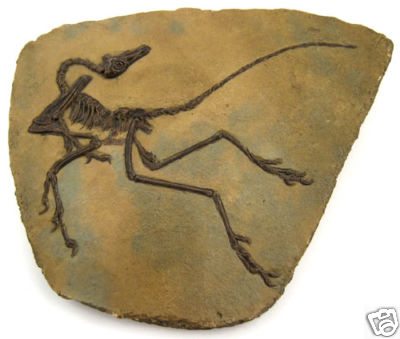
Archaeopteryx Fossil - A particulary important and still contentious discovery is Archaeopteryx lithographica, found in the Jurassic Solnhofen Limestone of southern Germany, which is marked by rare but exceptionally well preserved fossils. Archaeopteryx is considered by many to be the first bird, being of about 150 million years of age. It is actually intermediate between the birds that we see flying around in our backyards and the predatory dinosaurs like Deinonychus. In fact, one skeleton of Archaeopteryx that had poorly preserved feathers was originally described as a skeleton of a small bipedal dinosaur, Compsognathus. A total of seven specimens of the bird are known at this time.
Petrified wood (from the Greek root petro meaning "rock" or "stone"; literally "wood turned into stone") is the name given to a special type of fossilized remains of terrestrial vegetation. It is the result of a tree having turned completely into stone by the process of permineralization. All the organic materials have been replaced with minerals (most often a silicate, such as quartz), while retaining the original structure of the wood. Unlike other types of fossils which are typically impressions or compressions, petrified wood is a three dimensional representation of the original organic material. The petrifaction process occurs underground, when wood becomes buried under sediment and is initially preserved due to a lack of oxygen which inhibits aerobic decomposition. Mineral-laden water flowing through the sediment deposits minerals in the plant's cells and as the plant's lignin and cellulose decay, a stone mould forms in its place.
Amber is fossilized tree resin (not sap), which has been appreciated for its color and natural organic beauty since Neolithic times. Amber is used as an ingredient in perfumes, as a healing agent in folk medicine, and as jewelry. There are five classes of amber, defined on the basis of their chemical constituents. Because it originates as a soft, sticky tree resin, amber sometimes contains animal and plant material as inclusions.
The most common fossils of the megalodon are its teeth, which are morphologically similar to the teeth of great white shark but are more robust and more regularly serrated. The teeth of the megalodon can measure over 180 millimetres (7.1 in) in slant height or diagonal length, and are the largest in size of any known shark species.
Ammonites are an extinct group of marine invertebrate animals in the subclass Ammonoidea of the class Cephalopoda. These molluscs are more closely related to living coleoids (i.e. octopuses, squid, and cuttlefish) than they are to shelled nautiloids such as the living Nautalis species.
Ammonites are excellent index fossils, and it is often possible to link the rock layer in which they are found to specific geological time periods. Their fossil shells usually take the form of planispirals, although there were some helically-spiraled and non-spiraled forms (known as heteromorphs).
The name ammonite, from which the scientific term is derived, was inspired by the spiral shape of their fossilized shells, which somewhat resemble tightly-coiled rams' horns. Pliny the Elder (d. 79 AD. near Pompeii) called fossils of these animals ammonis cornua ("horns of Ammon") because the Egyptian god Ammon (Amun) was typically depicted wearing ram's horns. Often the name of an ammonite genus ends in -ceras, which is Greek (κέρας) for "horn". | |
|
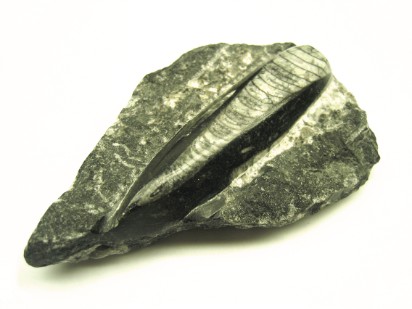
Orthoceras ("straight horn") is a genus of extinct nautiloid cephalopod. This genus is sometimes called Orthoceratites. Note it is sometimes misspelled as Orthocera, Orthocerus or Orthoceros (Sweet 1964:K222).
Orthoceras fossils are common and have a global distribution, occurring in any marine rock, especially limestones.
These are slender, elongate shells with the middle of the body chamber transversely constricted, and a subcentral orthochoanitic siphuncle. The surface is ornamented by a network of fine lirae (Sweet 1964:K224). Many other very similar species are included under the genus Michelinoceras.
The Gastropoda or gastropods are a large taxonomic class within the molluscs, a group of animals that are more commonly known as snails and slugs. The class includes snails and slugs of all kinds and all sizes: huge numbers of marine snails and sea slugs, as well as freshwater snails and freshwater limpets, and the terrestrial (land) snails and slugs. The class Gastropoda contains a vast total of named species, second only to the insects in overall number. The fossil history of this class goes all the way back to the Late Cambrian. There are 611 families of gastropods, of which 202 families are extinct, being found only in the fossil record. |



Fossilized Lobster
Lobsters are crustations closely related to crabs. Lobsters have been evolving for millions of years and have changed slighty since prehistoric times. Our speciman is a great example of this.
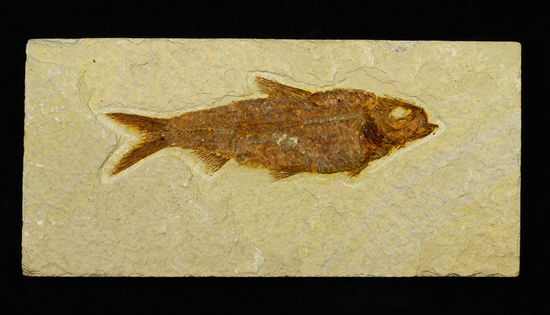
Fossilized Fish
Fish are one of the first creatures that lived on the Earth and have millions of different species.
|
Velociraptor, like other dromaeosaurids, had a large manus ('hand') with three strongly-curved claws, which were similar in construction and flexibility to the wing bones of modern birds. The second digit was the longest of the three digits present, while the first was shortest. The structure of the carpal (wrist) bones prevented pronation of the wrist and forced the 'hands' to be held with the palmar surface facing inwards (medially), not downwards. The first digit of the foot, as in other theropods, was a small dewclaw. However, whereas most theropods had feet with three digits contacting the ground, dromaeosaurids like Velociraptor walked on only their third and fourth digits. The second digit, for which Velociraptor is most famous, was highly modified and held retracted off of the ground. It bore a relatively large, sickle-shaped claw, typical of dromaeosaurid and troodontid dinosaurs. This enlarged claw, which could be over 6.5 cm (2.6 in) long around its outer edge, was most likely a predatory device used to tear into prey, possibly delivering a fatal blow.
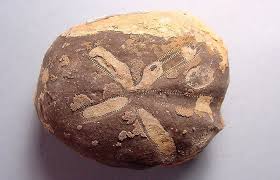
Sea urchins or urchins are small, spiny, globular animals which, with their close kin, such as sand dollars, constitute the class Echinoidea of the echinoderm phylum. They inhabit all oceans. Their shell, or "test", is round and spiny, typically from 3 to 10 centimetres (1.2 to 3.9 in) across. Common colors include black and dull shades of green, olive, brown, purple, and red. They move slowly, feeding mostly on algae. Sea otters, wolf eels, triggerfish, and other predators feed on them. Humans harvest them and serve their roe as a delicacy.
The name urchin is an old name for the round spiny hedgehogs that sea urchins resemble.
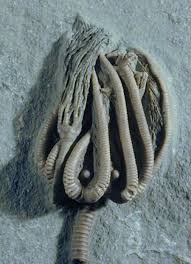
Crinoids, also known as sea lilies or feather-stars, are marine animals that make up the class Crinoidea of the echinoderms (phylum Echinodermata). Crinoidea comes from the Greek word krinon, "a lily", and eidos, "form". They live both in shallow water and in depths as great as 6,000 meters. Crinoids are characterized by a mouth on the top surface that is surrounded by feeding arms. They have a U-shaped gut, and their anus is located next to the mouth. Although the basic echinoderm pattern of fivefold symmetry can be recognized, most crinoids have many more than five arms. Crinoids usually have a stem used to attach themselves to a substrate, but many live attached only as juveniles and become free-swimming as adults.
There are only a few hundred known modern forms, but crinoids were much more numerous both in species and numbers in the past. Some thick limestone beds dating to the mid- to late-Paleozoic are almost entirely made up of disarticulated crinoid fragments.
Bivalvia is a class of marine and freshwater mollusks known for some time as Pelecypoda, but now commonly referred to simply as bivalves. As with Gastropoda and Cephalopoda, the term Pelecypoda is in reference to the animal itself while Bivalvia simply describes the shell. Other names for the class include Acephala, Bivalva, and Lamellibranchia. The class contains some 30,000 species, including scallops, clams, oysters and mussels.
Bivalves have a shell consisting of two asymmetrically rounded halves called valves that are mirror images of each other, joined at one edge by a flexible ligament called the hinge. The shell is typically bilaterally symmetrical, with the hinge lying in the sagittal plane.
Bivalves are unique among the molluscs, having lost their odontophore and radula in their transition to filter feeding.
Some bivalves are epifaunal; they attach to surfaces. Others are infaunal; they bury themselves in sediment. These forms typically have a strong digging foot. Some bivalves such as scallops can swim.
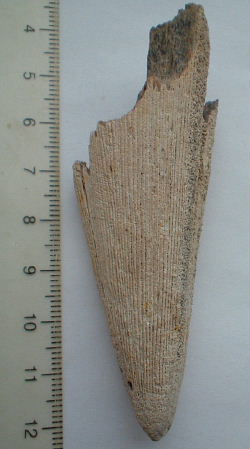
Marlins very common to find in the Atlantic and Pacific ocean. Marlins mainly live in open ocean and their diet is on tuna and mackerel. Marlins have live for thousands of years as the fossil shows. This bill fossil is at least 100,000 years old!
Brachiopods are a phylum of marine animals that have hard "valves" (shells) on the upper and lower surfaces. Most species of brachiopod went extinct during the P–T extinction over 250 million years ago, but many survive today.
Brachiopod valves are hinged at the rear end, while the front can be opened for feeding or closed for protection. Articulate brachiopods have toothed hinges and simple opening and closing muscles, while inarticulate brachiopods have untoothed hinges and more complex muscles. In a typical brachiopod a stalk-like pedicle projects from an opening in the hinge or from a hole in the larger valve, attaching the animal to the sea bed but clear of silt that would obstruct the opening.
Brachiopods have a mantle that secretes and lines the shell, and encloses the internal organs. The body occupies typically about one-third of the internal space inside the shell, nearest the hinge. The rest of the mantle encloses a water-filled space containing the lophophore, a crown of tentacles that filters food particles out of the water. In all species the lophophore is supported by cartilage and by a hydrostatic skeleton.
Septarian Nodules
Septarians are fossilized mud balls composed of calcite (the yellow centers), aragonite (the brown lines) and an outer grey layer of limestone. Septarians were formed during the Cretaceous period, 50 to 70 million years ago. Decomposing sea life formed into mud balls that dried, cracked and shrank trapping the cracks inside. Calcite from the shells of the sea life filled the cracks in the mud balls and a thin wall of the calcite was transformed into aragonite separating the heavy clay exteriors from the calcite centers.
|
Over the years the mueseum has been collecting many different types of fossils big and small. When we first started collecting fossils we bought smaller and less valuable fossils like our brachiopods and bivalves. However as time went on and we became more and more expirienced collectors we have bought larger and more valuable fossils like our Archaeopteryx Fossil and our Septarian Nodules. Today we are continuously looking for more fossils to add to our collection and to show to others on our website and our friends. |
|
|


3n!bkiBN,D4I3TFQ~~_3.JPG)